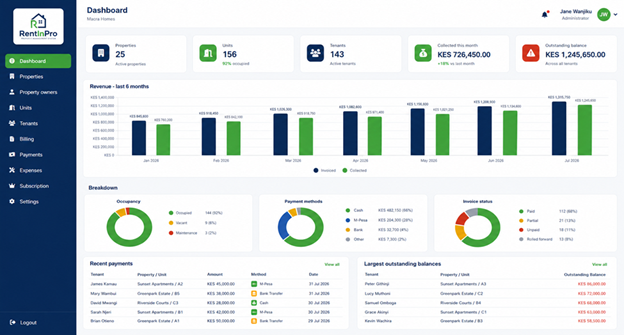
Managing rental property can start out as a simple job.
You have a few tenants, you know who has paid, you remember who owes rent, and you probably have a notebook or spreadsheet where you keep your records.
Then the number of tenants grows.
Suddenly, you are checking M-Pesa messages, updating spreadsheets, looking for payment records, following up on arrears, preparing receipts, calculating expenses, and trying to remember which property belongs to which owner.
This is where rental management software can make a big difference.
But with so many property management systems available, how do you know which one is right for you?
The best rental management software should not simply have many features. It should make your daily work easier, keep your records organised, and give you a clear picture of your properties and finances.
Here are some of the most important things to look for.
1. Start With Your Actual Needs
Before choosing software, think about the problems you are trying to solve.
Are you struggling to keep track of rent payments?
Do you have difficulty knowing which tenants have outstanding balances?
Are you spending too much time preparing receipts?
Do you manage properties for different owners?
Are you still using notebooks, Excel sheets, WhatsApp messages, or several different systems?
Your answers will help you know what features you actually need.
There is no point paying for complicated software filled with features you will never use.
2. Property and Unit Management Should Be Simple
A good rental management system should make it easy to record your properties and units.
You should be able to see which properties you manage, how many units they have, which units are occupied, and which ones are vacant.
This becomes especially important when you manage several properties.
Instead of opening different spreadsheets or searching through old messages, you should be able to find the information from one place.
3. Look for Proper Tenant Management
Tenant information should not be scattered across notebooks, phones, and spreadsheets.
A good system should allow you to keep important tenant and tenancy information together with the unit they occupy.
It should also help you know when a tenant moved in and what they are expected to pay.
For example, when a tenant is assigned to a unit, the system should make it easy to start their billing without having to manually create everything from scratch.
4. Automated Rent Billing Can Save a Lot of Time
One of the biggest advantages of rental management software is automated billing.
Imagine managing 50 or 100 tenants and having to create every month's invoice manually.
That can take a lot of time and can also lead to mistakes.
A good system should allow you to generate monthly invoices for active tenants in one action.
It should also keep track of unpaid balances so that arrears do not disappear between months.
This is particularly useful for landlords and agents who are managing a growing number of units.
5. Make Sure It Handles Partial Payments
Tenants do not always pay the full amount at once.
A tenant may owe KSh 20,000 and pay KSh 10,000 today, then clear the remaining KSh 10,000 later.
Your rental management system should be able to record this properly.
You should be able to see the amount paid, the remaining balance, and the payment history without doing the calculations yourself.
This small feature can save you from many unnecessary disputes.
6. M-Pesa Support Is Important in Kenya
For a rental management system in Kenya, payment tracking should take M-Pesa into account.
Many tenants pay rent through M-Pesa, and keeping track of transaction messages manually can quickly become difficult as the number of tenants increases.
Look for a system that allows you to record M-Pesa payments against the correct tenant and invoice.
It should also keep the M-Pesa confirmation code as part of the payment record.
This makes it easier to trace a payment when a tenant asks, "Did you receive my money?"
7. Tenants Should Get Proper Receipts
A simple M-Pesa message is not the same as a proper rental receipt.
A good rental management system should make it easy to generate receipts whenever a payment is recorded.
The receipt should clearly show important information such as the tenant, property, amount paid, and remaining balance.
For example, RentInPro automatically generates a numbered PDF receipt for recorded payments and includes the payment history for the invoice.
This gives both the landlord or agent and the tenant a clear record of what has been paid.
8. Arrears Should Be Easy to See
One of the most important questions for any landlord is:
Who owes me money?
Your rental software should answer this question quickly.
You should be able to see outstanding balances without going through every tenant one by one.
Good software should also carry unpaid balances forward so that arrears remain part of the tenant's account until they are cleared.
This can make rent follow-ups much easier.
9. Agents Need Owner Management
Rental management is slightly different for an agent managing properties on behalf of other people.
An agent needs to know more than how much rent has been collected.
They also need to know:
- Which property belongs to which owner
- How much rent was collected
- How much is outstanding
- What expenses were incurred
- How much commission the agent has earned
- How much should be reported to the property owner
This is why property owner management is an important feature for letting and property management agencies.
RentInPro allows agents to associate properties with their owners, set an agreed commission, and calculate the commission automatically each month.
10. Expense Tracking Matters
Property management is not only about collecting rent.
There are also repairs, maintenance, plumbing, electrical work, cleaning, and other property-related expenses.
Your software should allow you to record these expenses against the correct property.
This gives you a better understanding of how much each property is actually costing you.
For agents, it also makes owner reporting much easier because expenses can be included in the property's financial records.
11. Reports Should Be Easy to Understand
You should not need to be an accountant to understand your rental business.
A good rental management system should provide simple reports showing things such as:
- Expected rent
- Collected rent
- Outstanding balances
- Occupancy
- Property expenses
- Payment methods
- Agent commissions
This allows you to quickly see how your properties are performing.
It is also useful when you need to give a property owner a proper report instead of simply sending a WhatsApp message saying, "Rent was collected."
12. Check How the Software Charges You
Price is important, but do not look at the monthly fee alone.
Check what is included in the price.
Some systems charge separately for different features, users, properties, or modules. Others may have different packages depending on what you want to use.
Look for a pricing structure that makes sense for the size of your rental business.
For example, RentInPro bases its pricing on the number of active tenants being managed rather than the number of properties or units. Its plans currently start at KSh 1,000 per month for up to 20 tenants, and all plans include the main property management features.
13. Make Sure It Can Grow With You
You may only have 10 tenants today.
But what happens when you have 50?
What about 200?
The software you choose should be able to handle your growth without forcing you to move to a completely different system.
This is especially important for property agents who are constantly adding new properties and tenants.
14. Choose Software Built for Your Market
A rental management system should fit the way you actually manage property.
For landlords and agents in Kenya, features such as M-Pesa payment tracking, Kenyan currency, local rental practices, and property owner reporting can be much more useful than a system designed mainly for another market.
The software should fit your work instead of forcing you to change everything about how you operate.
15. Look for Something Easy to Use
This is often overlooked.
A system can have hundreds of features, but if it is difficult to use, you may end up going back to your notebook and Excel sheet.
The best rental management software should be simple enough that you can quickly:
- Add a property
- Add units
- Add tenants
- Generate invoices
- Record payments
- Issue receipts
- Check balances
- View reports
If these basic tasks are difficult, the software may not be the right fit for your business.
Why RentInPro?
If you are a landlord or letting agent in Kenya looking for a simple way to manage your rental business, RentInPro brings the main parts of property management into one system.
You can manage properties and units, keep tenant records, generate monthly invoices, track rent payments, record M-Pesa payments, issue PDF receipts, manage arrears, track expenses, and generate reports. Agents can also manage property owners and automatically calculate their agreed commissions.
The idea is simple: instead of keeping rental information in notebooks, spreadsheets, WhatsApp messages, and M-Pesa messages, you have one place where everything can be tracked.
RentInPro also offers a 3-month free trial with no credit card required, allowing landlords and agents to try the system before committing to a paid plan.
Final Thoughts
Choosing rental management software is an important decision.
Do not choose a system simply because it has the longest list of features. Choose one that solves the problems you actually face every day.
Look for software that makes rent collection easier, keeps tenant records organised, tracks arrears, provides proper receipts, handles your property expenses, and gives you clear reports.
For agents, make sure it can also separate properties by owner and help you keep track of commissions.
Most importantly, choose a system that you and your team will actually enjoy using.
The right rental management software should not make property management more complicated.
It should take the work off your desk.
0 Comments
No comments yet. Be the first to share your thoughts.